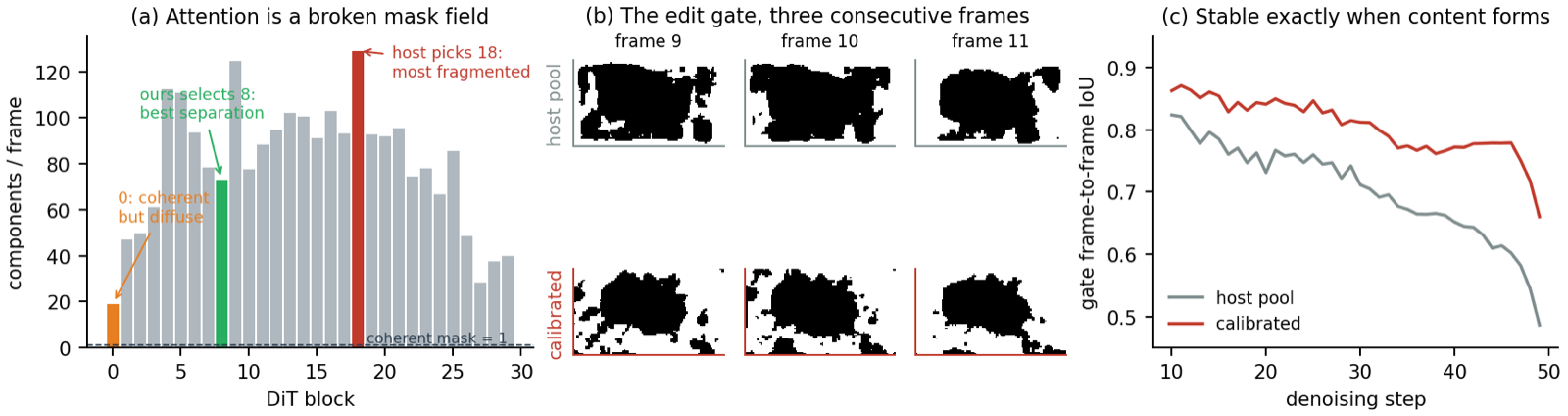
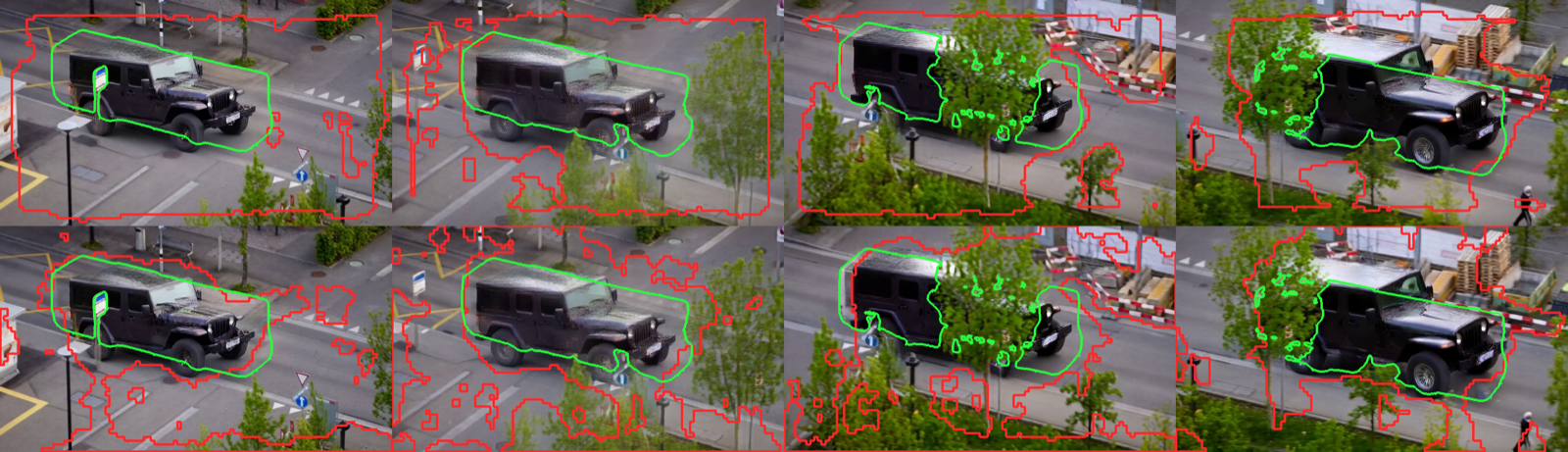
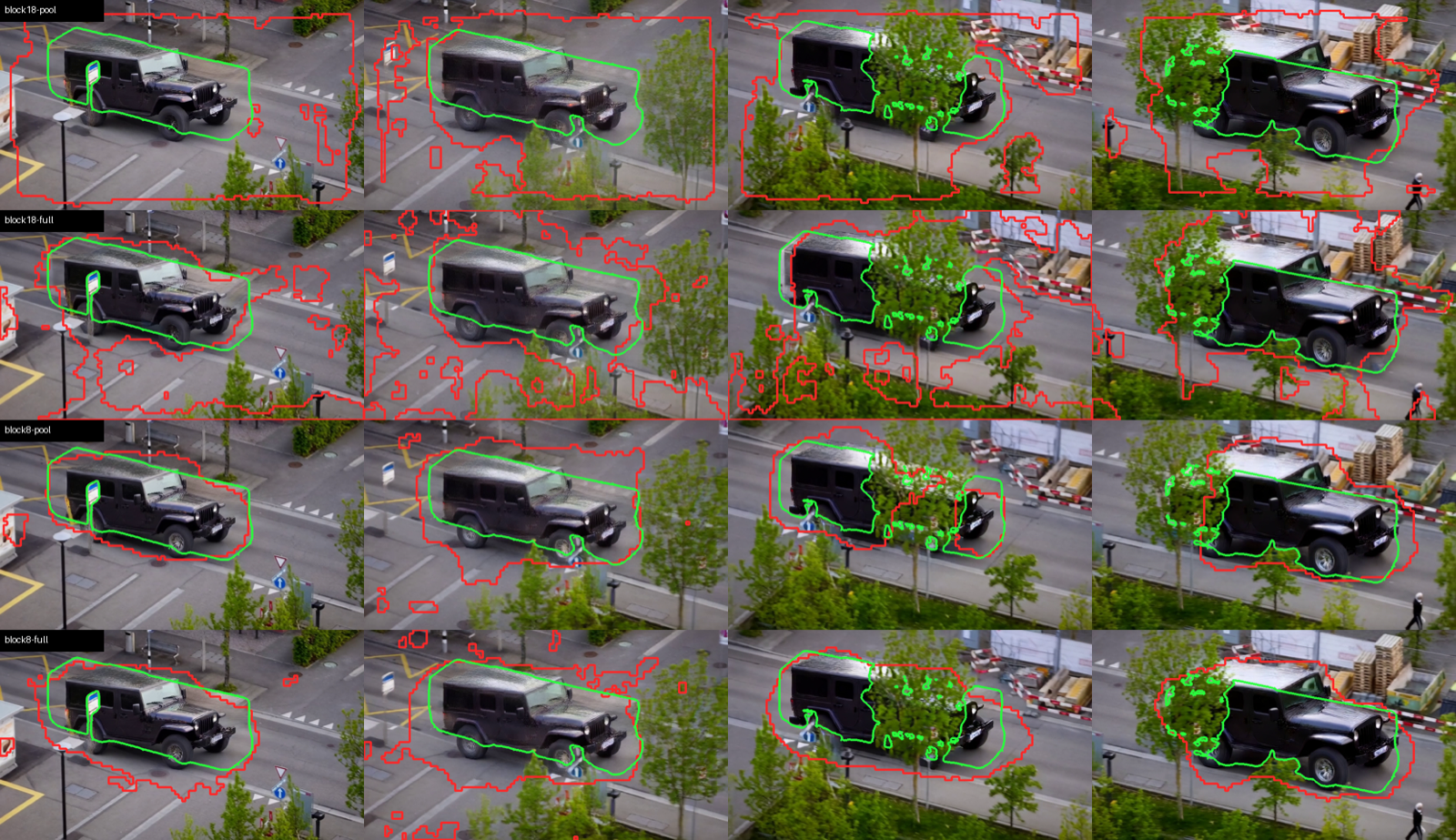
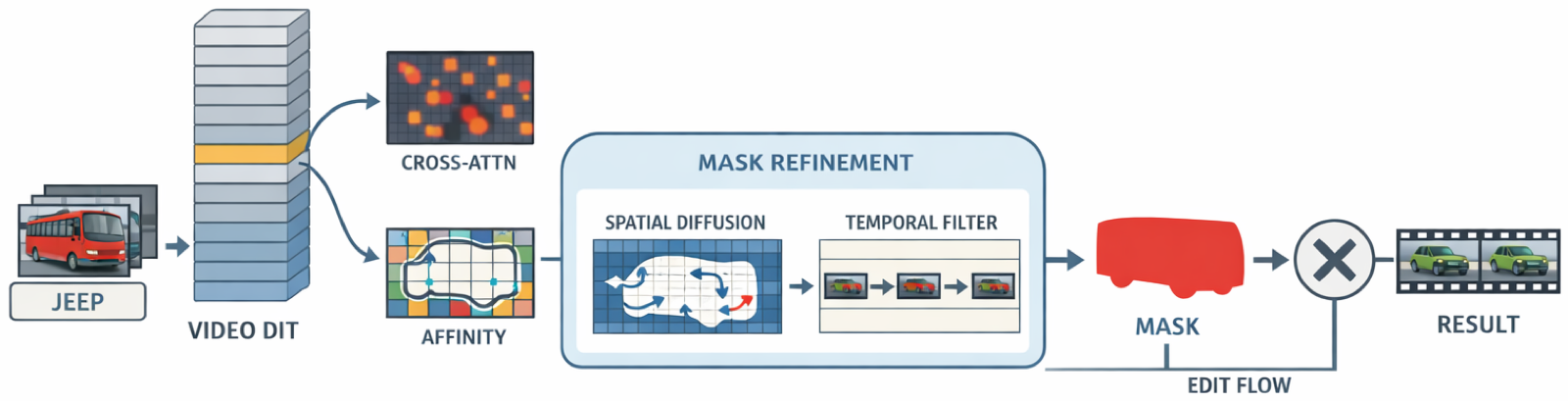
Training-free video editors use the diffusion transformer's cross-attention as a mask that decides where an edit lands. We show this signal is not a mask at all but an unstable latent field β fragmented into dozens of islands per frame, flickering between consecutive frames, extracted from a hand-picked layer that turns out to be the worst of the network. We diagnose the field layer-by-layer, split its defects into repairable (fragmentation, jitter) and unrepairable (missing figureβground separation), and calibrate accordingly: select the layer for the property no operator can recover, repair the rest with two axis-matched, training-free operators.
Probing every block of Wan2.1-T2V-1.3B (1,200 subject-token maps) shows the pathology is structural: the median map fragments into dozens of connected components where a mask has one; consecutive frames share less than half their mask area; and layer choice is a third failure surface β the coherent-looking block attends diffusely to half the scene (the "coherence trap"), while the hand-picked block is the most fragmented of all. An identical probe on CogVideoX-2b reproduces every finding.
FlowDirector's pooling (middle) vs. full calibration (right: selected extraction layer + repair operators). Each caption says where to look β FlowDirector's fragmented, flickering gate lets the edit spill outside the object; the calibrated gate keeps it contained.
FlowDirector repaints the foreground crewman's yellow shirt into a green hi-viz vest and rewrites his headset β collateral damage far outside the object. Calibration preserves both crew members.
Under FlowDirector's pooling, a translucent bus ghost stays fused to the jeep's front in the opening frames β a half-transformed hybrid. The calibrated edit is clean from the first frame.
FlowDirector's gate bleeds onto the pop-up goal net behind the player and half-erases it; calibration leaves the net standing while making the same character edit.
FlowDirector mangles the racket into a dark branch-like artifact mid-swing; calibration keeps the racket intact through the stroke.
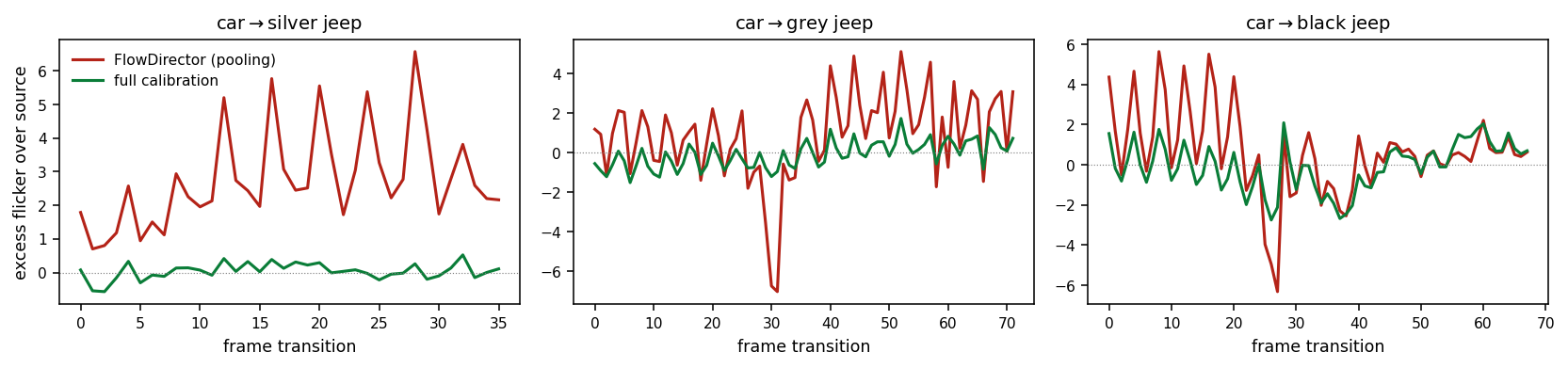
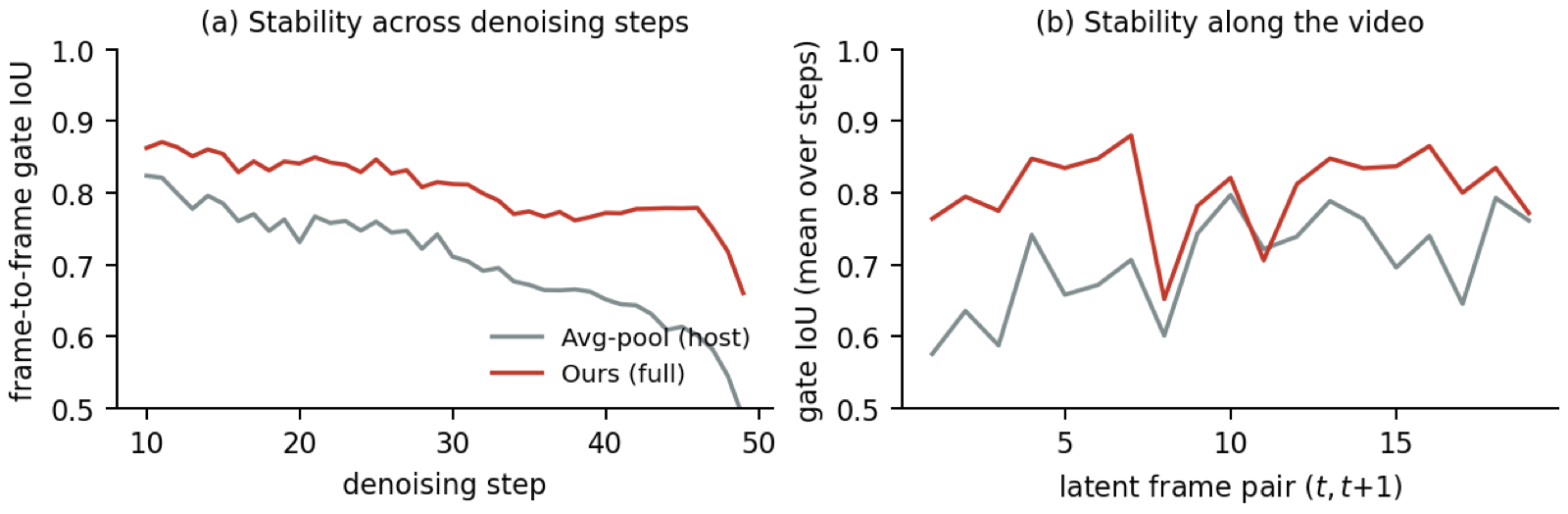
In stills the two edits look identical β in motion FlowDirector's jeep shimmers frame-to-frame (the gate flickers), while the calibrated jeep holds steady. The traces below quantify it.
Calibration renders a more defined jeep (tires, wheel arch, windshield) and holds it steady through the smoke; FlowDirector's vehicle blurs and pulses.
Inserting an object that does not exist in the source β a cap on a bear, a hat on a musician β leaves every external segmenter with nothing to segment. Queried for the absent object, an open-vocabulary detector doesn't fail gracefully: it returns a confident box on every video, usually the entire subject. The generator's own cross-attention is the only signal that responds to the query at all β which makes calibrating it the load-bearing problem.
FlowDirector stabilizes its noisy mask field by averaging the edit velocity over four independent noise resamples β 16 DiT forwards per denoising step. That averaging exists because the field is unstable. Calibration replaces it with structure: as the resample count drops to one, pooling's stability collapses while calibrated masks barely move β so full calibration at a quarter of the forwards (3.4Γ faster measured end-to-end) still beats FlowDirector's default configuration on both axes.
# FlowDirector baseline
python edit.py ... --mask_arm pool
# operator mode: swap pooling for the two repair operators
python edit.py ... --mask_arm full
# full calibration: also move extraction to the selected layer
python edit.py ... --mask_arm full --mask_block 8
The operators are ~150 lines of tensor ops on the attention heat; conductances are read from the forward pass FlowDirector already computes.
@inproceedings{maskfield2027,
title = {Mask Fields in Video Diffusion Transformers: Diagnosing and
Calibrating Internal Localization for Training-Free Editing},
author = {Anonymous},
booktitle = {Submitted to ICLR},
year = {2027},
}